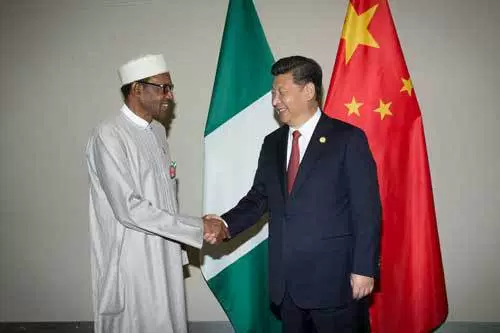
Minister of Foreign Affairs Geoffrey Onyeama on Wednesday said the
currency deal signed between Nigeria and China during the recent visit
of President Muhammadu Buhari to China would boost the economies
of both countries.
The minister, who was briefing State House correspondents in Abuja
on the outcome of the president’s visit to China, noted that the
currency deal would eventually make Nigeria a hub of the Chinese
currency.
According to him, the Chinese are looking for a hub in West Africa,
stressing that Ghana is interested in being the hub for the currency to
circulate it for those who want to use it but not compulsory.
He, however, explained that it had become attractive for China to make
Nigeria the hub because of the size of the country and economy,
adding that the currency deal would also give the country more
flexibility.
“So, if Nigeria is buying Chinese goods, for instance, it will be in our
interest to use the Yuan because we know there is a lot of squeeze for
the dollar.
“But, we still use the dollar. But if it is not enough and there are some
people who want to invest in the country, instead of crying that they
cannot take dollar out, there might be Yaun that they would be happy
to take out because it is now internationalised as a currency and they
can use it.
“So, it gives us a much larger option.
“As you know, a lot of importers now are complaining that they are not
able to access the dollars to buy goods and things like that.
“What it takes is that as the Chinese economy goes strong, there are
some pressures on them from the trading partners, international
financial institutions. They agreed that the money should be
internationalised.
“They were protecting it also. They did not allow it to be fully
exchangeable. But now, their economy is fully strong; they are looking
for a way to internationalise the currency.
“Now, they were saying essentially that they wanted to segment it,’’ he
said.
The minister said that for Southern Africa, South Africa was going to
be the sort of a hub for the currency.
Also addressing the correspondents on the issue of petroleum
distribution and fuel scarcity, Minister of State for Petroleum Ibe
Kachikwu assured that government would address the systemic issues
facing the distribution chain of the product.
“We are hoping that by July we will be able to sign up agreements that
will enable upgrades and joint venture of the refineries to take effect.
“We expect that to last for about 12 months, and we expect that by
2017 we should have all the refineries back where they ought to be.
“The target is that by 2018 we will reduce fuel import by 60 per cent
and by 2019 with our refineries producing 400,000 barrels, we will
exceed our refined importation and begin to export petroleum
products,’’ he said.
According to the minister, the present fuel queues are due to sabotage,
saying that some marketers are diverting the products to the
hinterlands for economic gains.
“As at today, we are delivering about 1,200 trucks.
“By weekend we should be delivering same number of trucks, it will
take a bit of days to even out but you can see improvement already.
“I hope by the end of next week, with the refineries helping us to stay
on course, every part of the country will get fuel,’’ he added.
NAN